
Reference: 0.38.309.007
MPN: 1125110052
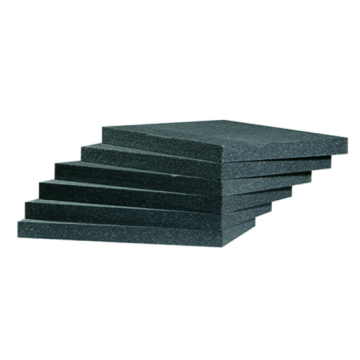
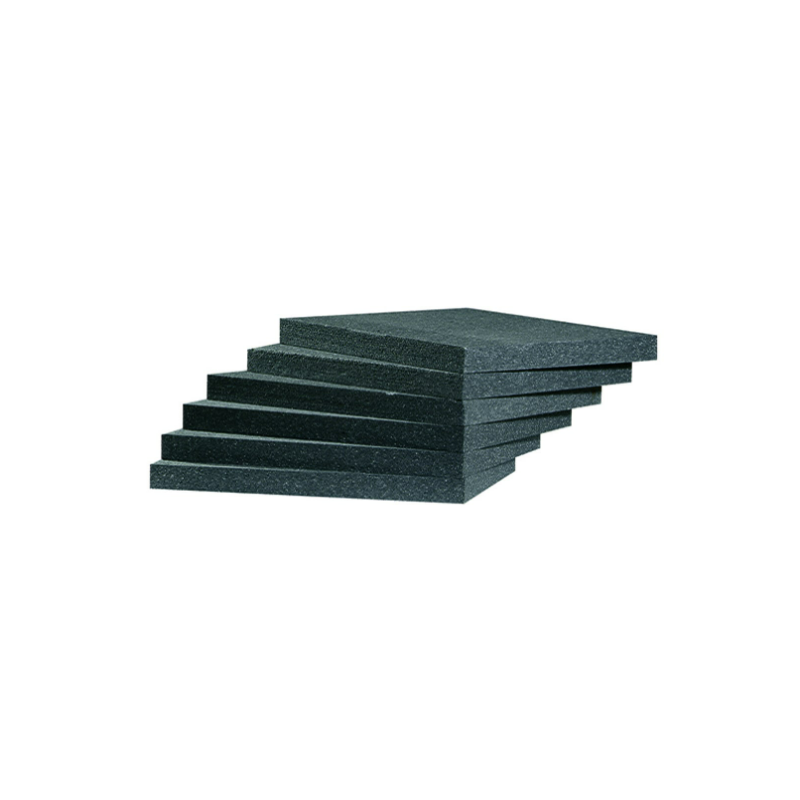
In stock 1-3 Working DaysExpanded Polystyrene Graphite EPS80 5cm
EPS is the common term used for Expanded Polystyrene. It is produced by polymerization of styrene, with pentane as the expanding gas, and its final form is in granules. It is used for the production of products used in Insulation, Construction, Decoration and Packaging. The products obtained are nothing more than a closed-cell foam with air, a composition which gives it excellent thermal insulation properties because 98 % of the volume is air. It does not contain CFC's or HCFC's.
The production process of Expanded Polystyrene from Inflatable Polystyrene has three stages:
1. The raw material (in 0.4-2.0mm diameter granules) is heated inside special machines called preexpanders with the help of steam at temperatures of 80 to 100oC and expanded. On expansion the density of the material drops from about 630 kg/m3 to 10-80 kg/m3 depending on the intended use. The tiny granules of the raw material swell up to 50 times. The pre-expanded grains consist of small closed cells containing air inside.
2. Intermediate Maturation & Stabilization: Pre-expanded EPS grains are stored in ventilated silos which facilitate the escape of pentane from the inside and its replacement by air. During this stage the granules also expel any moisture they contain.
3. Final Swelling & Moulding: The stabilized Expanded Polystyrene granules are transferred to special machines like block moulding or injection moulding presses where with the help of steam again they are expanded and agglomerated taking the form of the mould. In block presses this form is large blocks which are then cut into the form of slabs for thermal insulation uses and in moulding machines the final form is that of each mould.
The production process mentioned above results in blocks of Expanded Polystyrene with amazing properties for fulfilling all packaging needs. Any product, of any shape and size can be packaged with EPS that is why the uses that will be mentioned are not exhaustive.
Sales promotion : it has an attractive appearance, it is a modern material, the customer's logo can be printed on the outside, it is available in the market in various colours other than white, such as blue, green, etc.
Case conductor of electricity: high resistance to current leakage through its mass
Resistance to time: does not decompose, is not affected by water so it offers resistance to time
Low weight: consists of 98% air
Inert Material: is chemically neutral, does not dissolve in water
Does not burden the environment: contributes to the reduction of the Greenhouse Effect and Acid Rain, because by contributing to the thermal insulation of buildings it helps to reduce the energy used for heating and cooling, contributing to the drastic reduction of emissions of gaseous pollutants (CO2, SO2)
Recyclable material: environmentally friendly and 100% recyclable, non-toxic and completely inert, it does not contain chlorofluorocarbons (CFCs) or hydrochlorofluorocarbons (HCFCs) and has never contained them during its life cycle
Insulation - Construction - Decoration Self-extinguishing material for fire protection: can also be produced from self-extinguishing raw material
Adaptability: flexible material in terms of shaping, as a cut product it can be cut to any desired size, dimensions and shape
Mechanical properties: it is produced in a wide range of densities and particle sizes with corresponding mechanical properties, depending on the end use desired
Ease of application: considered among the easiest to use and install
Chemical resistance: in its cooperation with other building materials such as cement, etc.
Packaging Preservation of vitamin C : fruits and vegetables retain their vitamin C content for a longer period of time
Suitable for storing food and pharmaceutical material: food or pharmaceutical material sensitive to temperature changes ensure that it is kept at a stable temperature, protect it from large temperature changes ( temperature anti - shock or thermal shock ) and from destruction or breakage
It has a Certificate of Suitability: for use as a packaging material for food and beverages
Shock absorption: has a high shock absorption index and in the event of a fall or impact is the ideal material to protect sensitive products during transport and storage
Thermal insulation: it is an excellent thermal insulator and can give a thermal conductivity coefficient from λ = 0,035 W/m*K to 0,029 W/m*K depending on the production density and the type of raw material
Low weight: its use as a packaging material reduces the transport costs of the products
Resistance to compression: the high compressive strength allows several packages to be placed vertically, facilitating storage during transport and at the point of sale
Chemical resistance: it is chemically inert, so it can be used for packaging foodstuffs and other products without reacting with them
Adaptability: as a mouldable material (with moulds) it can be moulded into any shape to suit the needs of the packaging
Data sheet
Expanded Polystyrene Graphite EPS80 5cm
Reference: 0.63.814.500
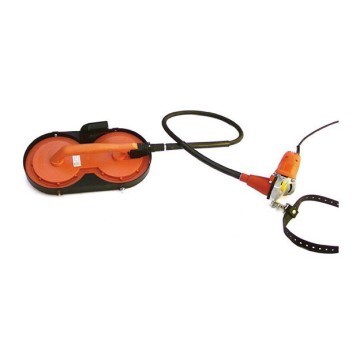
For sanding, smoothing, cleaning, polishing, removing wallpaper.
Reference: 1.46.999.030
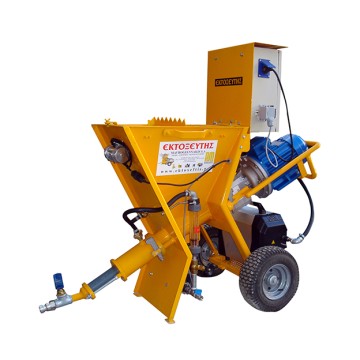
The company "MAYROGIANNAKIS S.A.", expands the variety of plaster mixing pumps with another pump ideal for mixing ready-made dry plasters and other colloidal materials. This pump is suitable for construction sites supplied with single-phase electricity, 230 Volt only.
Reference: 0.16.165.015
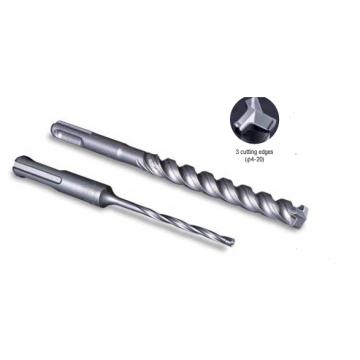
Ideal for Concrete, concrete blocks, mortars, reinforced concrete, plasters.
Reference: 0.16.165.014
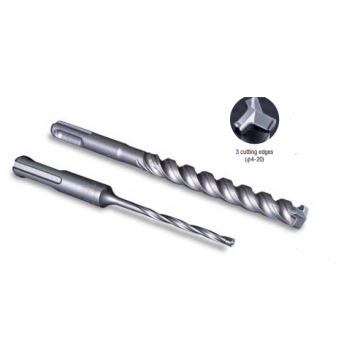
Ideal for Concrete, concrete blocks, mortars, reinforced concrete, plasters.
Reference: 0.38.826.162
Expanded polystyrene VITEXTHERM EPS 80 GRAPHITE 7 cm